24/7 Dispatch from 79 Delaware Ave, Stirling, NJ
Water Damage Restoration Service in Long Hill Township, NJ
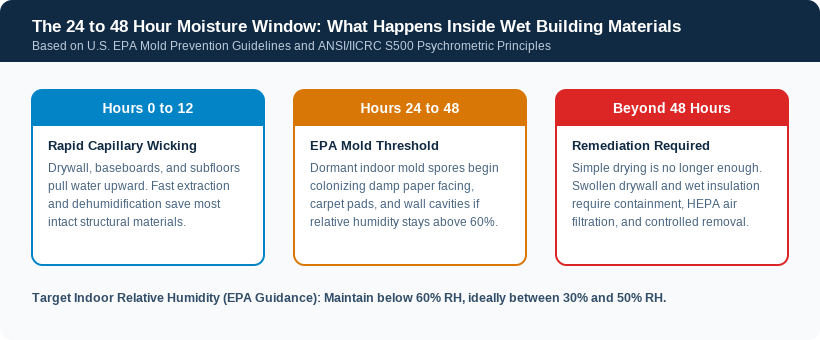
Standing water starts wicking into drywall, baseboards, and subflooring within minutes. The U.S. EPA recommends drying wet materials within 24 to 48 hours to help prevent mold growth. Call Mold Solutions NJ LLC for immediate extraction and monitored structural drying across Long Hill Township and neighboring towns.
How do we classify water damage before starting extraction?
Every restoration job starts by identifying the water source and contamination level defined in the ANSI/IICRC S500 Standard for Professional Water Damage Restoration. Treating sewage or river backwater the same way you treat a clean supply-line leak leaves hazardous microbes sealed inside your wall cavities.
| Water Category | Common NJ Sources | Required Field Action |
|---|---|---|
| Category 1 (Clean) | Burst copper or PEX supply pipes, water heater leaks, overflowing sinks | Rapid extraction, in-place drying of intact drywall and subfloors if under 48 hours |
| Category 2 (Gray) | Washing machine discharges, dishwasher leaks, groundwater sump seepage | Extraction, carpet pad disposal, antimicrobial treatment, monitored dehumidification |
| Category 3 (Black) | Passaic River floodwater, sewer backups, standing water left past 72 hours | Containment, removal of soaked drywall/insulation/carpet, HEPA filtration, disinfection |
What happens during our structural drying process?
Surface towels and consumer dehumidifiers only pull moisture from the air in the middle of a room. Water trapped behind baseboards, under laminate flooring, and inside sill plates stays wet for weeks unless you create controlled vapor-pressure differentials.
1. Moisture mapping with pin and thermal meters
We map the exact perimeter of hidden moisture behind painted drywall and underneath flooring using infrared cameras and calibrated pin moisture meters. That establishes an unaffected dry-standard baseline in the same home so we know the exact target moisture content for every stud and subfloor panel.
2. Commercial extraction and controlled flood cuts
Truck-mounted and portable extractors remove bulk water far faster than evaporation alone. Where Category 2 or Category 3 water has saturated drywall and insulation, we perform clean flood cuts (typically 24 inches above the waterline) to expose wet framing and remove unsalvageable insulation.
3. Psychrometric dehumidification and daily logging
We deploy Low-Grain Refrigerant (LGR) dehumidifiers and directional air movers sized to the room volume. Our technicians record indoor temperature, relative humidity, and material moisture readings daily until the structure returns to dry standard. If you are filing a homeowners claim, call (908) 738-8678 and we will provide the complete daily drying log directly for your adjuster.
Which local water emergencies do we handle most often in Morris and Somerset Counties?
- Passaic River and Great Swamp basin basement seepage: High groundwater in Stirling, Millington, Gillette, and Basking Ridge frequently triggers cove-joint leaks and sump pump failures during heavy rain.
- Winter frozen pipe bursts: Uninsulated exterior-wall plumbing in older colonial and split-level homes splits during hard freezes and floods finished basements and ceilings when temperatures thaw.
- Appliance and water heater failures: Second-floor laundry lines and aging basement water heaters can release hundreds of gallons in a single hour before anyone notices.
If water has already been sitting for more than 48 hours or you notice a musty odor, read our mold remediation service page or our local Long Hill Township water damage guide.
Frequently Asked Questions
How long does structural drying take after a basement flood or burst pipe?
Most Category 1 clean-water losses dry to equilibrium moisture content in 3 to 5 days using commercial LGR dehumidifiers and air movers. Dense materials like hardwood floors, plaster walls, or concrete slabs can require 5 to 7 days of monitored drying.
Should I run household box fans on wet drywall or carpet?
Never run fans until you confirm the water is clean Category 1 water. U.S. EPA Table 1 warns against operating fans on contaminated or unsanitary water because high airflow aerosolizes bacteria and mold spores into unaffected rooms.
Can soaked fiberglass insulation inside a wet basement wall be dried in place?
No. Both EPA guidance and ANSI/IICRC S500 procedures require removing and discarding wet fiberglass and cellulose insulation because trapped water inside a wall cavity prevents wood studs from drying within 48 hours.
What is the difference between Category 1, Category 2, and Category 3 water?
Category 1 is clean water from a supply line or faucet. Category 2 (gray water) comes from appliances like washing machines or sump pump seepage and contains chemical or biological contaminants. Category 3 (black water) includes sewage backups and Passaic River floodwater containing pathogens that require full porous-material removal.
Stop water damage before mold starts growing
Call Mold Solutions NJ LLC at (908) 738-8678 for immediate water extraction and structural drying anywhere in Long Hill Township, Stirling, Warren, Basking Ridge, or Berkeley Heights.