By Mold Solutions NJ LLC Technical Team | Updated November 29, 2026
Mold Remediation After Basement Flooding in NJ: Why Bleach Fails and How ANSI/IICRC S520 Containment Works
If basement mold after a New Jersey storm covers more than 10 square feet, sits inside wall cavities, or grew out of floodwater, household bleach will not fix it and wiping it openly spreads airborne spores into clean rooms. Both the CDC and the U.S. EPA set 10 square feet (roughly a 3 foot by 3 foot patch) as the ceiling for homeowner cleanup.
Below is how the updated 2024 ANSI/IICRC S520 standard grades basement mold, why bleach fails on porous framing, and the exact containment sequence that keeps spores out of your living space.
Why does household bleach fail on basement wood and drywall?
Bleach works on non-porous surfaces like glazed bathroom tile or glass because mold cannot grow roots into solid ceramic. Basement framing lumber, drywall paper facing, and unsealed concrete block are porous.
When you spray diluted bleach onto damp wood joists, the active sodium hypochlorite reacts with surface organic matter and neutralizes quickly, while the remaining water soaks into the wood grain. The visible stain fades, which looks clean for two weeks, but the underlying fungal hyphae survive and regrow as soon as basement humidity rises above 60 percent. Never mix bleach with ammonia or other cleaners, as the CDC warns that combination produces toxic chloramine gas.
How does ANSI/IICRC S520-2024 classify basement mold?
The fourth edition of the ANSI/IICRC S520-2024 Standard for Professional Mold Remediation replaces guesswork about mold color with three objective fungal conditions:
- Condition 1: Normal fungal ecology matching typical outdoor background spores with no active indoor colonization.
- Condition 2: Settled or airborne spores present above normal levels because an active colony is shedding spores nearby.
- Condition 3: Actual mold growth visible or hidden on damp building materials.
The goal of remediation is physical removal of Condition 3 growth and Condition 2 settled spores until the room returns to Condition 1. Attempting to "kill" mold in place with foggers alone leaves dead allergenic spores behind on framing and subfloors.
What does proper negative-air containment look like?
Disturbing dry or damp moldy drywall releases millions of microscopic spores into the air. If your basement stairwell is open or your forced-air furnace is running, those spores travel directly upstairs.
- Isolate the work zone: Technicians build a sealed 6-mil polyethylene barrier with a zippered entry flap and seal off HVAC supply and return registers inside the basement.
- Establish negative air pressure: A HEPA air filtration device (AFD) exhausts filtered air through a basement window, pulling clean air inward so spores cannot escape into the hallway.
- Remove porous materials and HEPA vacuum framing: Mold-damaged drywall and wet fiberglass insulation are double-bagged inside containment. Exposed joists and studs are mechanically abraded or wire-brushed, HEPA-vacuumed, and damp-wiped.
- Verify moisture elimination: Before containment comes down, wood moisture content is checked with pin meters and basement humidity is stabilized below 50 percent RH.
What should you do next?
Measure the affected area first. If growth is under 10 square feet on bare tile or metal and the water was clean, careful ventilation and detergent cleaning may be enough. If it touches drywall, insulation, wood joists, or exceeds 10 square feet, call Mold Solutions NJ LLC at (908) 738-8678 or review our mold remediation service page to schedule a Stirling-dispatched inspection.
Frequently Asked Questions
Do I need to pay for mold lab testing before removing visible basement mold?
In most cases, no. Both the CDC and U.S. EPA state that if you can see or smell mold, you do not need to test to identify the species before removing it and fixing the moisture source. Testing is typically reserved for post-remediation verification (PRV) by an independent indoor environmental professional or hidden-mold disputes.
Why did the musty basement smell come back after I wiped the walls with bleach?
Household bleach is mostly water. On porous materials like drywall paper or basement wood framing, the chlorine breaks down on the surface while the water soaks deeper into the pores, leaving embedded mold roots alive and supplying extra moisture.
What indoor humidity level stops basement mold in New Jersey summers?
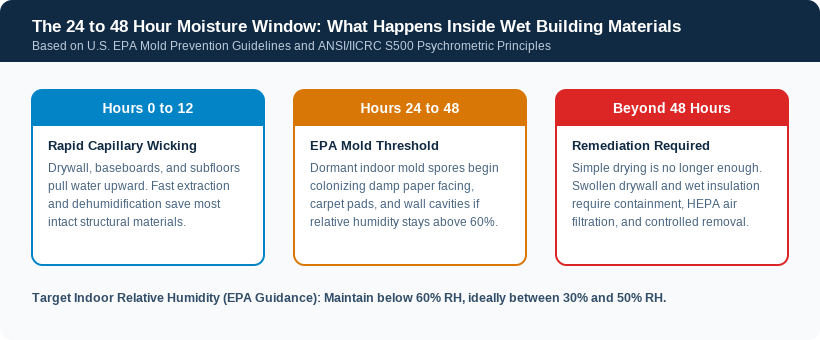
U.S. EPA guidelines recommend maintaining indoor relative humidity below 60 percent, and ideally between 30 and 50 percent. In humid Morris and Somerset County summers, a dedicated basement dehumidifier drained to a sump pit or floor drain is usually required.
Suspect hidden mold behind basement drywall in Long Hill Township?
Call (908) 738-8678 to reach Mold Solutions NJ LLC. We pinpoint hidden moisture with thermal imaging and remove mold safely under negative-air containment.