By Mold Solutions NJ LLC Technical Team | Updated November 29, 2026
Water Damage Restoration in Long Hill Township, NJ: The First 48 Hours, Local Flood Thresholds, and What Gets Saved
Water damage restoration in Long Hill Township comes down to a 24 to 48 hour clock: stop the source, extract standing water, and bring wet drywall and framing back to dry standard before indoor mold colonizes. Even shallow floodwater can soak carpets and subflooring. FEMA reports that over 40 percent of flood insurance claims come from outside high-risk flood zones.
This guide gives you the exact Passaic River flood thresholds that affect Stirling, Millington, and Gillette, an audit of which wet building materials can be dried versus discarded under federal guidelines, and the documentation steps that protect an insurance claim.
Why does water damage escalate so fast in Long Hill Township basements?
Long Hill Township sits in a low-lying stretch of the upper Passaic River basin where heavy rain raises both river levels and surrounding groundwater tables at the same time. We reviewed the official National Weather Service MARFC flood impact record for the Passaic River near Millington gauge (40.6800 N, 74.5289 W) on November 29, 2026: at 7.0 to 7.5 feet, backwater already floods Warren Avenue in Stirling, Morristown Road in Gillette, and backyards along Madison Street, and by 8.0 feet it reaches Valley Road commercial lots and Whitebridge Road.
Hydrostatic pressure beats perimeter drains
Even when river water stays hundreds of yards away from your house, saturated soil creates hydrostatic pressure under your concrete slab. Water pushes upward through the cove joint where the basement floor meets the foundation wall, often outpacing a single aging sump pump or failing completely if storm winds knock out power.
Finished basements hide moisture behind drywall
Unfinished concrete basements dry relatively cleanly once pumped out. Finished basements in Stirling and Basking Ridge have wood sill plates, fiberglass batts, and gypsum drywall resting directly on the slab. Capillary action pulls water 12 to 24 inches up drywall paper within hours, creating a dark, wet cavity that stays above 60 percent relative humidity long after the floor looks dry.

What should you do in the first 60 minutes after finding standing water?
Sequence matters in the first hour. Doing steps out of order puts you at electrical risk or spreads contaminated water into dry rooms.
- Check electrical safety before stepping into water: If water has reached basement outlets, extension cords, or the lower furnace panel, shut off power at the main breaker only if the panel is in a dry area. Otherwise stay out and call an electrician or emergency services.
- Shut off the water source if it is plumbing-related: Close the main shutoff valve on the street-side foundation wall for burst pipes, or turn off the individual angle stop behind a leaking toilet or sink.
- Verify whether the water is clean before using fans: The U.S. EPA Table 1 cleanup guideline explicitly warns not to use fans before confirming the water is clean and sanitary. Blowing air across groundwater seepage or sewage aerosolizes bacteria across the house.
- Photograph the waterline before pumping: Take wide room photos and close-ups against a ruler or baseboard before moving furniture so your insurer can see the peak water height.
If standing water is already touching finished drywall, carpet, or hardwood floors in Long Hill Township, call Mold Solutions NJ LLC at (908) 738-8678 right away. Our Stirling crew brings truck-mounted extraction and calibrated moisture meters directly to your door.
Which wet building materials can be dried, and which must be discarded?
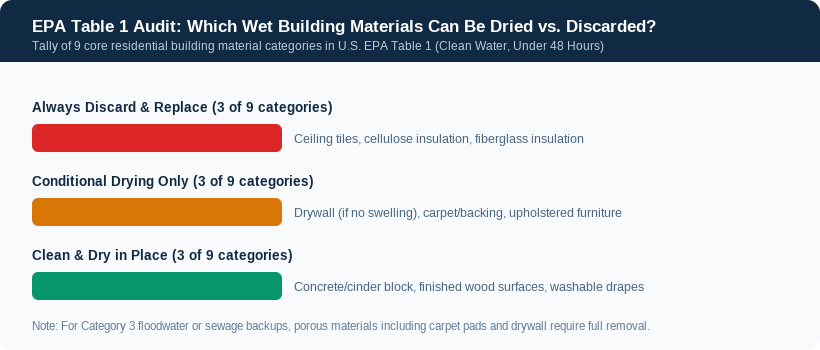
Homeowners often ask whether a restoration crew is removing too much drywall or trying to save wet carpet that should be thrown out. To give a clear benchmark, we audited the 9 core residential building material categories listed in U.S. EPA Table 1 (Clean Water Damage Within 24 to 48 Hours) on November 29, 2026: exactly 3 of 9 categories must always be discarded and replaced (ceiling tiles, fiberglass insulation, cellulose insulation), 3 of 9 can be dried only under strict conditions (drywall with no swelling, carpet with dry subfloor, upholstered furniture), and 3 of 9 can routinely be cleaned and dried in place (concrete/cinder block, finished wood, washable drapes).
| Material | Clean Water (< 48 Hours) | River Floodwater / Sewage (Category 3) |
|---|---|---|
| Drywall / Gypsum Board | Dry in place only if seams are intact and no swelling occurs; ventilate cavity | Cut and discard 12 to 24 inches above waterline; disinfect studs |
| Fiberglass or Cellulose Insulation | Discard and replace; traps water against framing | Discard and replace inside containment |
| Carpet and Pad | Extract and dry carpet within 48 hours; replace soaked pad in most cases | Discard both carpet and pad; sanitize subfloor |
| Concrete / Cinder Block | Extract standing water; dry with dehumidifiers and air movers | Extract, scrub with antimicrobial detergent, HEPA dry |
How does professional structural drying prevent secondary mold?
According to the U.S. EPA Brief Guide to Mold, Moisture and Your Home, indoor relative humidity must stay below 60 percent, and ideally between 30 and 50 percent, to stop mold growth. Standard drying follows psychrometry, which is the science of balancing air temperature, relative humidity, and airflow so moisture evaporates out of wood and concrete faster than spores can germinate.
Why air movers alone make humidity worse
Placing high-speed fans without matching Low-Grain Refrigerant (LGR) dehumidification evaporates water off the floor and pushes it straight into the air. When indoor relative humidity spikes above 70 percent, damp air condenses on cool upper drywall, ceiling joists, and furniture, creating secondary mold in rooms the water never touched.
Verifying dry standard before removing equipment
Under the ANSI/IICRC S500 Standard, a building is not dry when it feels dry to your hand. Technicians measure unaffected wood framing in the same house (usually 8 to 12 percent moisture content) and keep dehumidifiers running until affected framing returns within 2 to 4 percentage points of that dry standard.
What happens if water sits longer than 48 hours?
Once damp drywall, tack strips, or subflooring stay wet past 48 hours, the job shifts from simple water mitigation to controlled mold remediation. Opening a wall cavity after mold colonies have formed without polyethylene containment and negative-air HEPA scrubbers blows spores into your home's HVAC return vents and multiplies cleanup costs.
If you are already seeing dark spotting along baseboards or smelling dampness after a storm, read our post-flood basement mold guide or visit our water damage restoration service page for full dispatch details.
What should you do next?
You now know the local Passaic River flood triggers, the 48-hour drying deadline, and which materials EPA guidelines allow you to save. Start by shutting off the source and taking waterline photos right now. Then call Mold Solutions NJ LLC in Stirling at (908) 738-8678 so we can extract standing water, set commercial dehumidifiers, and document the dry-out for your insurer.
Frequently Asked Questions
Does homeowners insurance cover basement flooding from the Passaic River in Long Hill Township?
Standard homeowners policies typically cover sudden internal water events such as burst pipes or appliance failures, while surface floodwater from the Passaic River requires a separate flood insurance policy. Sump pump failure or sewer backup usually requires an explicit water-backup endorsement on your policy.
How do I tell if drywall behind my baseboards is still wet?
Surface touch is unreliable because gypsum absorbs water from the bottom edge upward behind latex paint. A restoration technician uses a pin-type moisture meter and an infrared thermal camera to compare suspect walls against an unaffected dry wall in the same house.
Can I turn on my basement dehumidifier and skip calling a restoration crew?
A consumer 50-pint dehumidifier can help after a minor clean-water spill on bare concrete, but it cannot pull bound moisture out of soaked carpet pads, subfloors, or insulated wall cavities within the 48-hour mold window. Once water touches drywall or insulation, commercial LGR dehumidification and targeted extraction are needed.
Is groundwater seeping through a basement floor joint clean water?
No. Groundwater enters through soil and concrete foundation cracks, picking up organic matter and microbes along the way. Under ANSI/IICRC S500 guidelines, groundwater seepage is treated as Category 2 or Category 3 water depending on contamination load, not clean Category 1 water.
Need emergency water extraction in Long Hill Township right now?
Call (908) 738-8678 to reach Mold Solutions NJ LLC at 79 Delaware Ave, Stirling. We respond 24/7 across Long Hill Township, Basking Ridge, Warren, Watchung, and Berkeley Heights.