By Mold Solutions NJ LLC Technical Team | Updated November 29, 2026
Fire and Smoke Damage Cleanup Timeline in NJ: Stopping Acidic Soot Corrosion Before Day 3
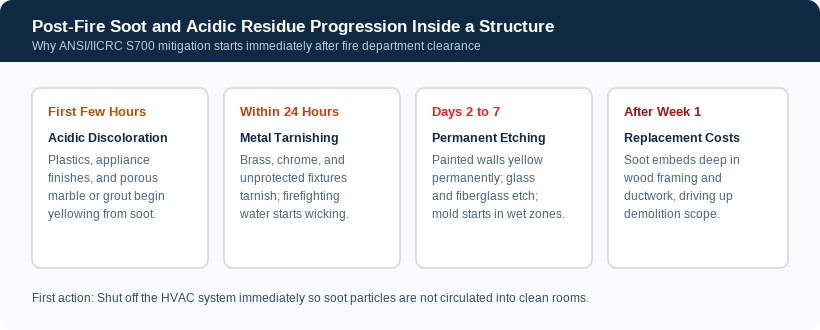
After a residential fire is out, acidic soot begins discoloring plastics and porous grout within hours, tarnishing chrome and brass within 24 hours, and permanently etching glass and painted walls within days. Shutting off your HVAC system and starting residue mitigation under the ANSI/IICRC S700-2025 Standard decides whether surfaces can be cleaned or must be torn out.
This guide breaks down the post-fire chemical clock, how different smoke residues behave, and why firefighting water must be extracted at the exact same time as soot cleanup.
What happens to surfaces hour by hour after a house fire?
Combustion of modern household materials (carpet fibers, polyurethane foam, PVC wire jacketing, and cabinetry) releases acidic chlorides and oily carbon compounds. When those compounds mix with humidity from firefighting hoses, they form corrosive residues.
Why is turning off the HVAC system step one?
If your central air or forced-air furnace cycles on after a fire or oil furnace puffback, the return vents pull fine soot particles into the blower cabinet, evaporator coil, and supply trunks. Within ten minutes, a localized kitchen or basement incident becomes a whole-house smoke odor remediation project. Switch the thermostat to OFF and leave it off until the ductwork is inspected.
How do restoration technicians match cleaning chemistry to the smoke type?
| Smoke Type | Typical Source | Field Cleaning Method |
|---|---|---|
| Dry Smoke | Fast-burning wood, paper, framing | HEPA vacuuming and dry chemical soot sponges before wet wiping |
| Wet / Synthetic Smoke | Smoldering plastics, foam cushions, rubber | Alkaline degreasers, specialized emulsifiers, controlled agitation |
| Protein Residue | Burnt meat or stovetop grease | Enzyme and solvent cleaning of invisible yellow films plus hydroxyl treatment |
| Fuel Oil Puffback | Misfiring basement oil burner | Petroleum-specific soot removers, HEPA scrubbing, HVAC decontamination |
Why must firefighting water be dried immediately alongside soot removal?
Fire departments protect lives and stop flame spread by saturating ceilings, walls, and attics with high-volume hoses. That water drains straight into subfloors and basements. Without rapid water damage extraction and dehumidification within 24 to 48 hours, homeowners face both fire soot and active mold growth in the same structure.
What should you do next?
Once the local fire department clears you to re-enter, switch off the HVAC thermostat, avoid touching soot-covered walls, and call Mold Solutions NJ LLC at (908) 738-8678. Our Stirling team handles emergency stabilization, firefighting water extraction, and full fire damage restoration across Long Hill Township and surrounding Morris, Somerset, and Union County towns.
Frequently Asked Questions
Should I wash soot off my walls before the insurance adjuster arrives?
No. Wiping synthetic or oil-based soot with standard household soap smears carbon deeper into porous paint and can make a cleanable wall require full replacement. Photograph the damage, keep the HVAC off, and let trained technicians dry-sponge and neutralize the residue.
How does smoke reach bedrooms on the second floor after a basement or kitchen fire?
Hot smoke expands under pressure and travels through stairwells, recessed light cans, plumbing chases, and HVAC return ducts. Because warm air moves toward cooler exterior walls, soot often concentrates in closets and upper corners far from the flames.
How long does smoke odor remediation take after a small kitchen fire?
A localized kitchen grease or protein fire typically requires 2 to 4 days of residue degreasing, HEPA air scrubbing, and hydroxyl or thermal-fog odor neutralization depending on whether smoke entered the HVAC ductwork.
Need fast post-fire soot removal and water extraction in NJ?
Call (908) 738-8678 directly. Mold Solutions NJ LLC responds 24/7 from 79 Delaware Ave, Stirling, NJ 07980.